161 Clean and Reliable Grid Affordability Act
Descriptions > White Backgrounds
Publication date: 2026/08/14
There
is one thing that has a lifespan shorter than a beer keg at a
fraternity party. It is alternating current (AC) generated
electricity. To store generated electricity it must be converted to
direct current (DC) then be put into a battery material for storage.
This
article is being written in response to the new Illinois directive
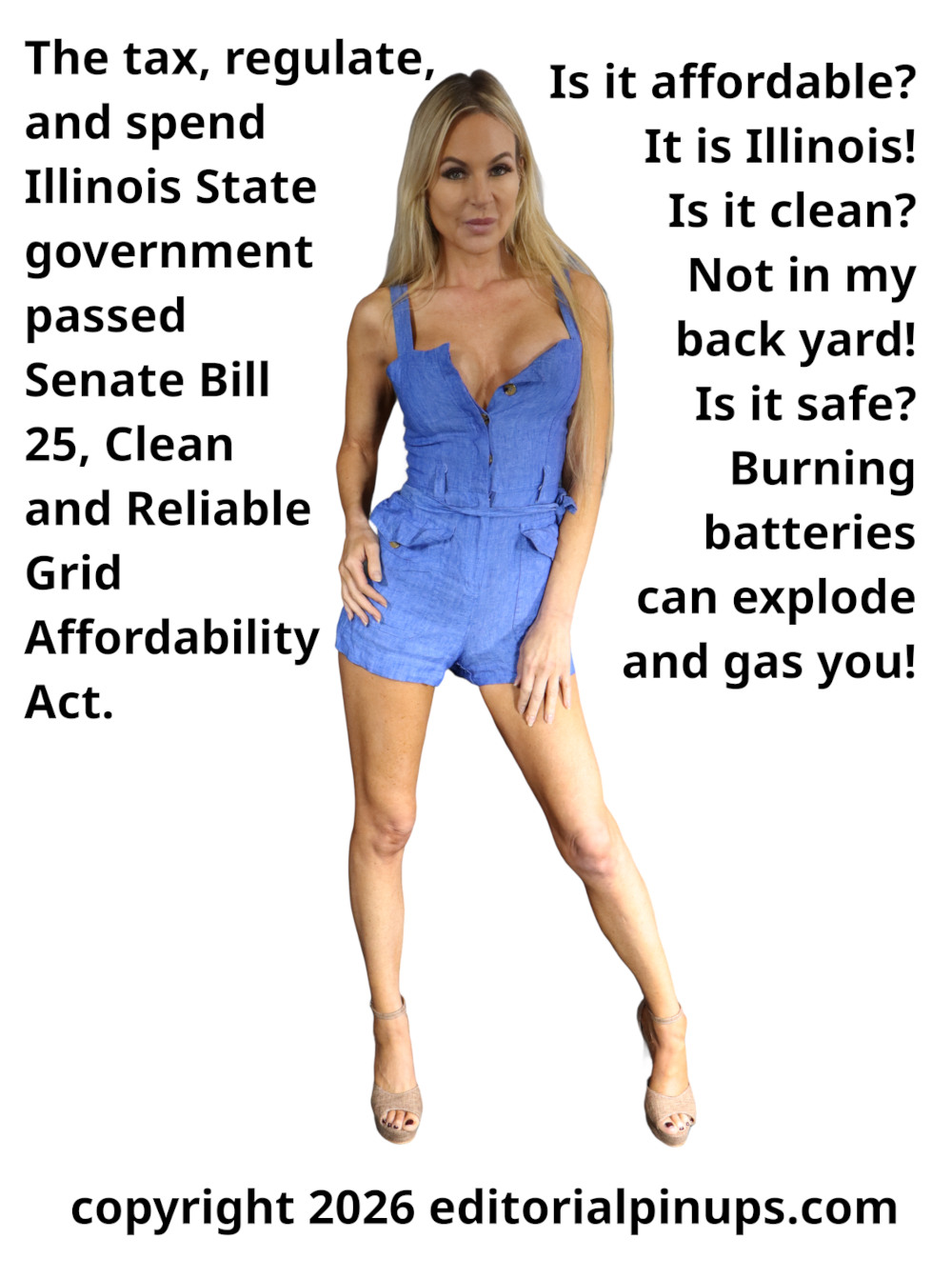
Senate Bill 25, Clean and Reliable Grid Affordability Act (CRGA), SB
25. One part of the bill, Establish a State procurement of 3GW of
grid-scale battery storage by 2030: Battery storage represents an
essential technology that will meet Illinois’ growing energy
capacity needs and lower utility bills. This is unproven and has
scientific flaws.
To
have a properly working power grid it must be determined what the
peak needs are and create a collection of reliable generation
stations to meet those peak needs. There are many ways to generate
electricity. They include hydro, coal burning, natural gas, nuclear
plants, and windmills and solar panels. All generate electricity
which has no shelf life on its own.
Therefore,
storage farms need to be created if it is desired to create a stored
backup.
There
are many questions that need to be answered for these storage farms.
How long does the battery backup need to last before shut down or
power restart? What is the safety factor in having this many
batteries in one location? In determining the size of the backup
needed, exactly what power needs need to be served, all power
functions or specific items? What power storage (battery) materials
will be used to create this backup? What is the potential
environmental mess from the harvesting of the materials for the
batteries? If these are the same battery materials used in electric
vehicles, what does that do to the EV market as increased demand for
a natural resource drives up the price of the resource?
According
to search.brave.com the answers are interesting. Batteries
themselves can last between two and four hours until full discharge
or power system resumption. If the batteries are used to try and
balance out the power there is an inefficiency of process. The power
generation and use is AC and batteries are DC. The power generation
to charge the batteries must be converted from AC to DC during
storage then reconverted from DC to AC for use. There is a loss in
power for this to happen.
The
safety factory of battery farms is already being called into
question. Keep in mind that we are not supposed to dispose of
Lithium Ion batteries in the garbage can. The reason, there is a
danger that the batteries can catch fire. From search.brave.com,
putting those fires out requires:
Putting out a battery farm fire
requires large volumes of water, specialized fire suppression
systems, and strict safety protocols to manage thermal runaway and
toxic gas release.
Water Volume and Application
- Massive Quantities: Unlike standard fires, battery farm fires require thousands to tens of thousands of gallons of water to cool the cells below ignition temperature and stop the thermal runaway cascade.
- Sustained Flow: Water must be applied continuously and in high volume directly to the battery packs, not just to visible flames, as surface extinguishment does not stop internal chemical reactions.
- Cooling Priority: The primary goal is thermal equilibration of the entire pack, which can take hours and significant water reserves.
Suppression Systems and Agents
- Specialized Extinguishers: For initial response or smaller cells, Class D extinguishers (for lithium metal) or aerosol-based systems (like Stat-X) may be used, though standard ABC dry chemical extinguishers are often ineffective for large-scale thermal runaway.
- Containment Tools: EV fire blankets or containment structures are used to prevent the fire from spreading and to concentrate cooling efforts.
- Submersion: In some cases, fully involved battery packs are submerged in water containers to ensure complete cooling and prevent reignition.
Safety and Monitoring
- Toxic Gas Hazard: Fires release toxic and flammable vapors (including fluorine), requiring firefighters to use full respiratory protection and maintain safe distances.
- Reignition Risk: There is a high risk of reignition for up to 72 hours after the initial fire is suppressed, necessitating continuous monitoring and cooling.
- Electrical Safety: All power sources must be isolated before suppression efforts begin to prevent electrocution and additional energy input to the fire.
Rock
Island County Illinois is having hearings on a proposed battery farm
in Milan Illinois. Fire, safety, and environmental issues lead the
discussion.
After
safety issues, there is the choice of battery materials which faces
multiple interesting dilemmas. First, there is the harvesting of the
necessary materials from the ground. This is proven to be a very
messy and liquid chemical or water and energy dependent system. The
actual carbon footprint seems to be ignored because it is not in our
back yard.
The
key to electricity is proper generation capabilities. Electricity
must be generated, then delivered. Per search.brave.com A/C generated
power can travel 300 to 500 miles. High-Voltage Direct Current
(HVDC) can travel 1000+ miles.
Electricity
in and of itself must be used as it is generated. That is true with
pretty much all power generation. Diesel, gasoline, natural gas,
when used to an energy purpose are also used right away. Motors of
all sorts create and use energy. The internal combustion engine uses
fuel to produce energy either directly in the case of most
automobiles. Diesel and natural gas similarly. Don’t confuse the
fuel with the product.
There
are carbon foot prints for all types of fuel. Even Hydro power has
ecological concerns. Just ask the fish.
I
looked at Geneseo Illinois to see how they have designed their
municipal power system. From their web site
https://www.cityofgeneseo.com/departments/electric-utility/:
The Electric Utility Department is responsible for the maintenance and operations of the City’s electric generating facilities and its electric distribution system. Eric Rowold is the Director of Electrical Operations.The Geneseo Municipal Electric Plant began generating electricity for the citizens of Geneseo on October 31, 1933. The Plant currently serves 3,600 customers.The peak load has increased from 200 kilowatts in 1933 to 20,185 kilowatts in 1995.The Plant was completely remodeled in 1946-1947 and additions were made to the building in 1961, 1966, 1967, 1973, 1998, and 2002.The generating capacity of the Plant has increased from an installed capacity of 720 kilowatts in 1933 to 37,747 kilowatts in 2015. Of this capacity, 29,840 kilowatts comes from diesel and natural gas; 3,000 kilowatts come from wind, 3,690 kilowatts come from coal and 944 kilowatts from solar.In 1973 an interconnection with Iowa-Illinois Gas and Electric Company, now Mid-American Energy, was added. Giving us emergency power and added power capabilities.The generating Plant houses eight diesel engines with a total horsepower of 41,615. Seven of the engines can run on natural gas or diesel.A modern distribution system of the Plant operates at 4,160 volts and 12,470 volts.The administrative building was built in 1967. Line garages were added in 1968 and 1983.A substation was installed on Stewart Street in 1972. An additional substation was installed at the Plant in 1989.The Utility operates and maintains the LED street lighting for the City.Recent Improvements include installing a fiber optic backbone which serves the Utility in monitor and control of the electrical system.The City’s network ties departments together.AMR electric meters have been installed.In 2007 SCR emission controls were being installed.In 2009 two Vensys model 77 wind turbines were installedIn 2009 the utilities became a market in the MISO market ( Click Here to learn more on MISO)In 2015 the utilities install a 1,232 KW DC Solar Array
I
have left messages with Eric Rowold but at this publication time I
have received no call back. If there is a change in this status I
will update.
Illinois
is stating in the legislation that the goal is to phase out all
fossil fuel (coal, diesel, natural gas, etc) generated power. The
problem is, there are limits to the other technologies. Proper
systems include real backup. All power generation methods have their
limitations, so why rule any out?
Wind
is good when there is wind but not too windy. Windmills need to be
locked if the wind exceeds speeds over 55 to 60 mph to avoid damage
to equipment and grid overload.
Solar
is good when the sun is out, but useless when not.
Hydro
is generally considered good but can have environmental concerns
including continuous water supply and affects on fish life. Some
hydro plants divert water from other locations and uses to stay
running.
Fuel
powered generation like all fuel powered anything there is the
availability of the fuel and the spent byproduct of the fuel. Proper
operation means care is taken with all fuel forms including proper
supply management and proper byproduct cleaning and disposal.
The
big question is why does Illinois seem to be so hell bent on power
storage and eliminating all fossil fuel based systems ahead of their
time? What science do the have that these battery farms are
environmentally friendly when they have catastrophic environmental
startup consequences?
Should
not efficient power systems be created with American resources for
proper power system security? Until electrical storage technology
becomes more practical, safe, and truly affordable without government
subsidies, emphasis should be placed on upgrading generation
capabilities under all conditions. There is also a need to make sure
the delivery lines are efficient and up to date.
The
CRGA seems to be legislation designed for a specific business type.
But Illinois Governor JB Pritzker is known for crony capitalism.
Here is just another example.